Cheers Michael. I guess I also would have known that had I read through the article as well... in any case, that's one awesome Chuanr. By the way (if you're still reading), do they add the 儿 to 串 there in the Opposite End of China?
Yeah, we use 儿 on the end of 串儿. But the word is used only as a measure word for 烤肉, as in 五串儿烤肉, literally "five sticks of roasted meat". Often the 串儿 will be replaced by the simple 个, as Uyghurs could care less about proper Mandarin usage!


4 comments:
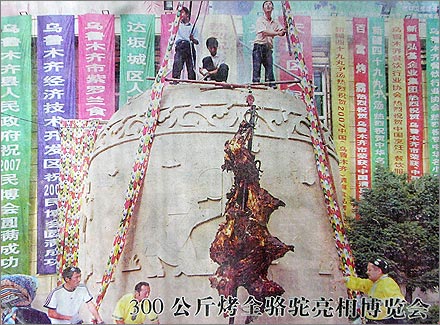
Is that a single or double humped camel?
That's a double-humped camel. See the two charred humps on the right side of the photo? The neck is pointing down, and the feet up, for reference.
Cheers Michael. I guess I also would have known that had I read through the article as well... in any case, that's one awesome Chuanr. By the way (if you're still reading), do they add the 儿 to 串 there in the Opposite End of China?
Yeah, we use 儿 on the end of 串儿. But the word is used only as a measure word for 烤肉, as in 五串儿烤肉, literally "five sticks of roasted meat". Often the 串儿 will be replaced by the simple 个, as Uyghurs could care less about proper Mandarin usage!
The Uyghur word, by the way, is kevap.
Post a Comment